
Federal Release Paths
The Federal Bureau of Prisons administers federal sentences across a national system. Research found no BOP institution in Adair County. An Adair County detainee can still enter federal custody if a federal case or authority supports the transfer. When that happens, disappearance from the Franklin Street jail reflects a receiving agency, not community release.
A federal prison term may end with release to the community, but federal supervision can continue through the courts and probation system. A person can also move through a residential reentry setting, transit status, another sovereign's custody, or immigration custody. The BOP locator speaks only to BOP status.
| BOP wording | Reasonable reading | Needed cross-check |
|---|---|---|
| Released plus past date | Departure from BOP custody on that date | Federal docket and other custodians |
| Not in BOP custody | No current BOP custody | Context and another authority |
| In Transit | Federal movement continues | Do not call it release |
| Future date | Projected and changeable | Recheck later |
Search a Federal Release
The official BOP Inmate Locator covers federal inmates from 1982 forward and is updated daily. Identifier searches accept the BOP Register, DCDC, FBI, or INS number. A name search includes optional age, race, and sex fields. Stable identifiers reduce same-name errors.
- Choose identifier search when a federal number is known.
- Otherwise enter the name and use optional identity fields cautiously.
- Compare the register number and all displayed biographical details.
- Read the location and release date together.
- Record the search date, then compare the result with the federal docket.
The official federal locator capture shows the correct public search entry point.
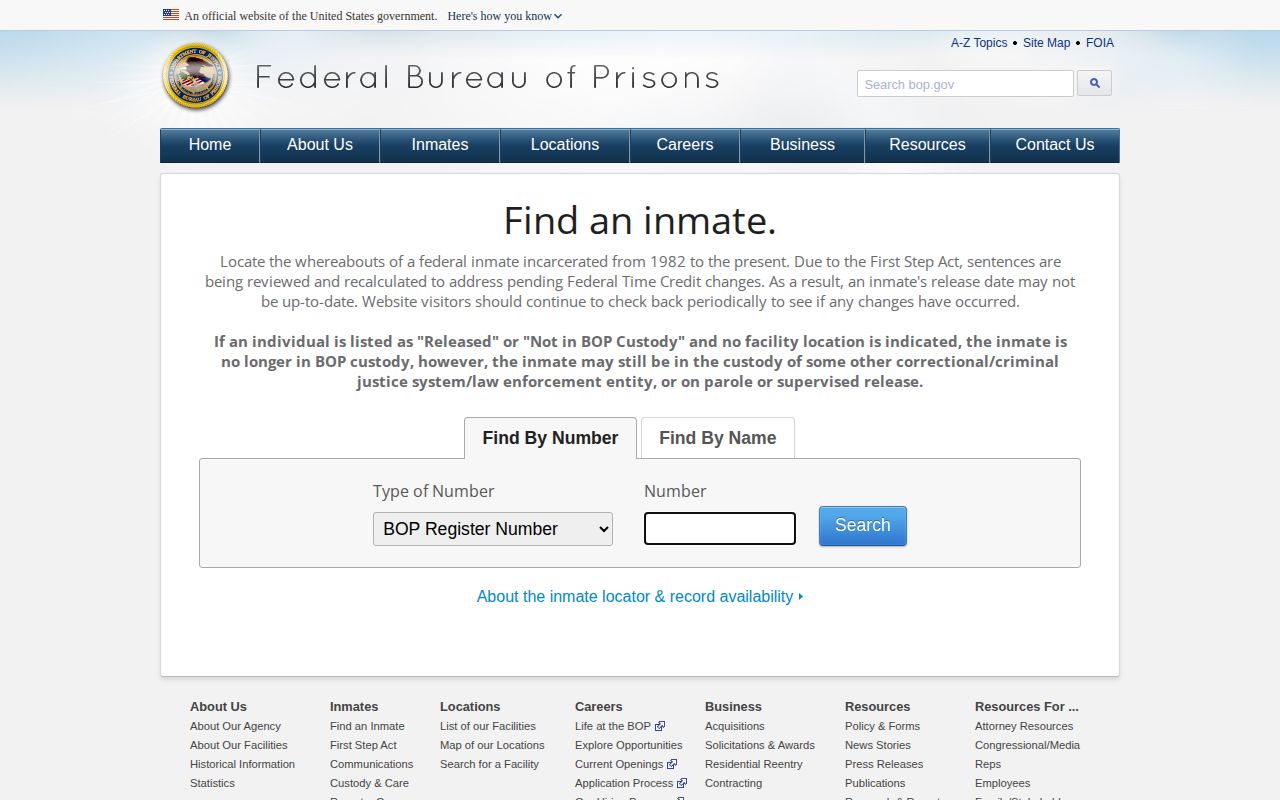
It establishes the interface and system scope, not that a particular person returned to Adair County.
Federal Status Is Limited
A past release date with no prison location generally indicates departure from BOP custody on that date. “Not in BOP Custody” can also apply to people managed outside a BOP-operated institution. Neither phrase proves that all federal supervision ended. It also does not exclude a Missouri warrant, county hold, ICE action, or another jurisdiction's custody.
- Federal release
- Departure from BOP custody, subject to the context shown in federal records.
- In transit
- Movement under authority, often involving the U.S. Marshals Service, not freedom.
- Projected date
- A future date that may change after sentence recalculation.
- Supervised release
- A court-controlled community period after imprisonment, separate from BOP confinement.
The BOP locator records explanation is the best source for interpreting the public result. Preserve BOP's own wording rather than translating every non-prison status into “released.”
Adair Transfer to Federal Custody
The Adair County sheriff records route can establish that a local booking ended and identify the destination. Ask for the admission and release times, release type, destination, receiving agency, and hold or detainer information that is open under law. If it names federal authorities, move to the federal sources.
A county court docket generally covers Missouri charges, while a federal prosecution is recorded in federal court. A local charge can remain pending during federal movement, and separate authorities can act in different sequences. Only the originating records can show which agency controlled each stage.
Federal Records and Contact
BOP's public locator is the first record route. For a person released before the locator's 1982 coverage, BOP directs historical inquiries to the National Archives. Helpful details include full name, birth date or approximate age, race, and approximate incarceration dates. Additional modern records may require a BOP Freedom of Information Act or Privacy Act request.
Federal Bureau of Prisons system
Local presence: No BOP institution identified in Adair County
Public locator: bop.gov/inmateloc
Coverage: Federal inmates from 1982 to present
Older records: National Archives route described by BOP
Additional records: BOP FOIA/Privacy Act process
Ask for the specific incarceration or release record and include the federal register number. Privacy limits can affect disclosure, especially when the requester is not the subject or an authorized representative.
U.S. Marshals Movement
The U.S. Marshals Service handles federal prisoners awaiting proceedings, movement, and safekeeping. No public name-searchable USMS release locator was found. Its Prisoner Tracking System is operational, not a public search portal. Therefore, “in transit” or a Marshals handoff must not be presented as community release.
Use the federal court docket or release order and the BOP locator when a person enters BOP custody. For additional USMS records, a focused FOIA request is the fallback, subject to ordinary exemptions and privacy limits. The federal court event can establish legal authority, while the custodial agency establishes physical movement.
The Adair County release-search path helps connect the sheriff event to federal custody without substituting the state MODOC search for a BOP case.
After a Federal Release
Community return cannot be inferred from the word “Released” alone. Check the federal judgment for supervised-release terms and the latest docket activity. If the record points to ICE, use the immigration locator. If Missouri or another jurisdiction assumed custody, check that named system. Avoid broad searches unsupported by the case trail.
A BOP future date is not an actual event. Sentence recalculation can change it. Likewise, absence from the locator does not erase the federal court record. Record the precise status, date, and source so later changes can be reconciled.
A federal release record is not an Adair County release log. The sheriff documents when its booking closed, while BOP documents the federal sentence phase. If dates overlap, keep both records and identify the handoff. That is more reliable than choosing whichever public system updated first.
For older cases, the National Archives route may need approximate incarceration dates because the locator begins in 1982. Modern requests should include the register number, institution if known, and exact event sought. Broad requests can take longer and face privacy limits. A narrow release-event request helps separate prison departure from later court supervision.
Identity checking matters across national records. A common name can produce several federal results, while a nickname may produce none. Match the register number, age, race, sex, and federal case details without guessing. If BOP shows a release date, cite it as a BOP custody date. Do not convert it into an Adair County arrival date, a final end of supervision, or proof that no other authority acted next.
Federal Release Record Sequence
A useful federal timeline begins with the local handoff when an Adair County booking is involved. The sheriff record should identify the date, time, and receiving authority. A federal court docket may then show detention orders, plea or trial events, judgment, sentence, and later supervised-release activity. The BOP record documents the prison phase. Keeping all three sources in date order prevents a local transfer from being mislabeled as a federal release.
“In Transit” deserves special care. The U.S. Marshals Service moves prisoners for court proceedings, designation, medical needs, and transfers. A transit entry does not state that the person is free, and it may not identify a final institution. Wait for a stable BOP location or an affirmative release event. If a court order appears first, remember that operational processing and another hold can affect when physical custody changes.
A future BOP release date is also limited. Sentence computation can change after credit review, court action, disciplinary decisions, or other authorized adjustments. Quote the date as displayed and label it projected when it is in the future. Once the date passes, recheck the location and status. A past date without a facility location generally supports departure from BOP custody, but another authority still may have acted.
Older cases require a different archive. BOP says the public locator reaches 1982 to the present. For earlier incarceration, the National Archives request should include full name, birth date or approximate age, race, and approximate custody dates. These details help distinguish people with similar names. A modern FOIA or Privacy Act request should instead identify the register number, institution, event, and date range as closely as possible.
After prison, the federal judgment may impose supervised release administered through the federal court and probation system. This is not BOP imprisonment, but it means the criminal case remains active in a community-supervision phase. A BOP “Released” result should therefore be written as release from BOP custody, unless the court record separately establishes completion of supervision. If ICE or a state authority received custody, name that transfer and follow the new system rather than broadening the BOP result.
Public Record Search
Sponsored Results